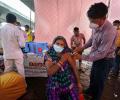
When a person gets an infection even after being vaccinated against it, it is called a breakthrough case.

FIFA collected 2,761 samples prior to the tournament and another 626 during it, including 108 collected on non-matchdays, as part of the largest-ever World Cup testing programme.

Amid a spike in coronavirus infection in parts of Maharashtra, Mumbai has witnessed 36.38 per cent rise in the active COVID-19 cases since February 8, as per the city civic body.

Most employment surveys suffer from drawbacks such as limited data coverage, infrequent data collection, and time lag

With this latest spike, the total cases in the country stand at 16,38,871.

The case fatality rate has declined to 1.83 per cent, the ministry data stated.

On a continuous upward trajectory, India's recovery rate has touched 78 per cent.

India registered a 13 per cent decrease in new COVID-19 cases in the past week but the number of fresh infections was still the highest around the world, the World Health Organisation has said.
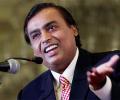
In Friday's market rally post the corporate tax cut, the country's top business promoters recouped more than two-thirds of the losses that they suffered in the post-Budget sell-off in equity markets.

Maharashtra, Karnataka, Andhra Pradesh, Uttar Pradesh and Tamil Nadu are the states with most cases.

The number of active cases dropped to 14,01,609.

He said in the last 8-10 days, the active cases in the state stood in the range of 5,000-6,000.

From conducting merely 10 tests per day on January 30, the daily average has crossed more than 11 lakh, the ministry adding this demonstrates an exponential increase in the daily COVID-19 testing in the country.

This is the seventh consecutive day when COVID-19 cases increased by more than 30,000.

This is the sixth consecutive day when COVID-19 cases increased by more than 30,000.
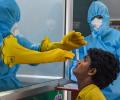
Experts feel the figures are modest for a count of the size of 1.3 billion and "much more number of tests" are needed to combat COVID-19 outbreak in the country.
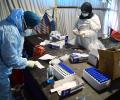
In a letter to states and UTs on Monday, Additional Secretary in the Union Health Ministry Arti Ahuja advised them to pay attention to this aspect immediately and increase the testing in a strategic manner keeping in view the trend of case positivity in specific areas.
India is the fifth worst-hit nation by the COVID-19 pandemic after the United States, Brazil, Russia and the United Kingdom, according to the Johns Hopkins University data.
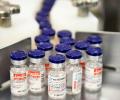
'Its efficacy is 97.6 per cent.'

'Enterprises have become more demanding in terms of their productivity expectation from their employees.'

Detailed order, to be passed on Monday, will consider green tribunal's decisions

With as many as 2,30,599 COVID-19 cases, Maharashtra continues to remain the worst-affected state, followed by Tamil Nadu (1,26,581) and Delhi (1,07,051).

'People are just putting the mask below their nose.' 'They are only protecting the mouth, but not the nose.' 'People need to understand that it is the nose which has to be protected.'

'Antiviral treatment will have no change. Spike protein change may affect the immunity protection.'

'A few of our players first entered WADA's Registered Testing Pool (RTP) during 2015 ICC World Cup. Our issue is NADA's handling of samples and how their Dope Control Officers (DCO) work. That is something we are not convinced about and we have told that to ICC also'

The number of active cases remained below 5 lakh for the fifth consecutive day.
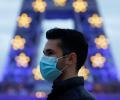
The B.1.640.2 variant has been reported by researchers at institute IHU Mediterranee Infection in at least 12 cases, and has been linked to travel to African country Cameroon.

After a long hiatus of more than 20 months, the government had on November 26 announced the resumption of scheduled international commercial flights from December 15.
The count of active cases has further reduced to 24,19,907, which is 8.84 per cent of the total infections, while the national COVID-19 recovery rate has improved to 90.01 per cent, the data showed.

The COVID-19 active caseload remained below four lakh for the third consecutive day.

A total of 5,15,385 COVID-19 patients have recovered so far with 19,870 patients having been cured and discharged in the last 24 hours till 8 am.

It took 110 days for the COVID-19 cases in the country to reach one lakh and just 59 days more to go past the nine-lakh mark.

This was the fourth consecutive day that COVID-19 cases in the country have increased by more than 26,000.

The number of people who have recuperated from the disease has surged to 1,03,94,352, pushing the national COVID-19 recovery rate to 96.96 per cent, while the case fatality rate stands at 1.44 per cent.

While the lockdown hit employment in all age groups, it hit the employment of youngsters who are less than 29 years of age much more. The lockdown also hit women more than it has affected men, reveals Mahesh Vyas.
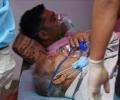
The number of active cases of the coronavirus infection in the country has gone up to 37,45,237, accounting for 16.53 per cent of its total caseload, while the national COVID-19 recovery rate was recorded at 82.39 per cent.
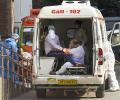
ICMR's serological survey, whose findings will be made public next week, suggests that the rate of contagion may be a lot higher in most-affected cities such as Delhi, Mumbai, and Pune.

Turns out, women have more diverse preferences related to sexual pleasure than believed.

Most of those who tested positive either recently arrived from African countries or were in contact with such people.

Delhi, Mumbai and Kolkata have already reached their peak in case numbers in the past seven days, said Manindra Agrawal, a professor at IIT Kanpur and one of the researchers associated with the Sutra Covid model.
